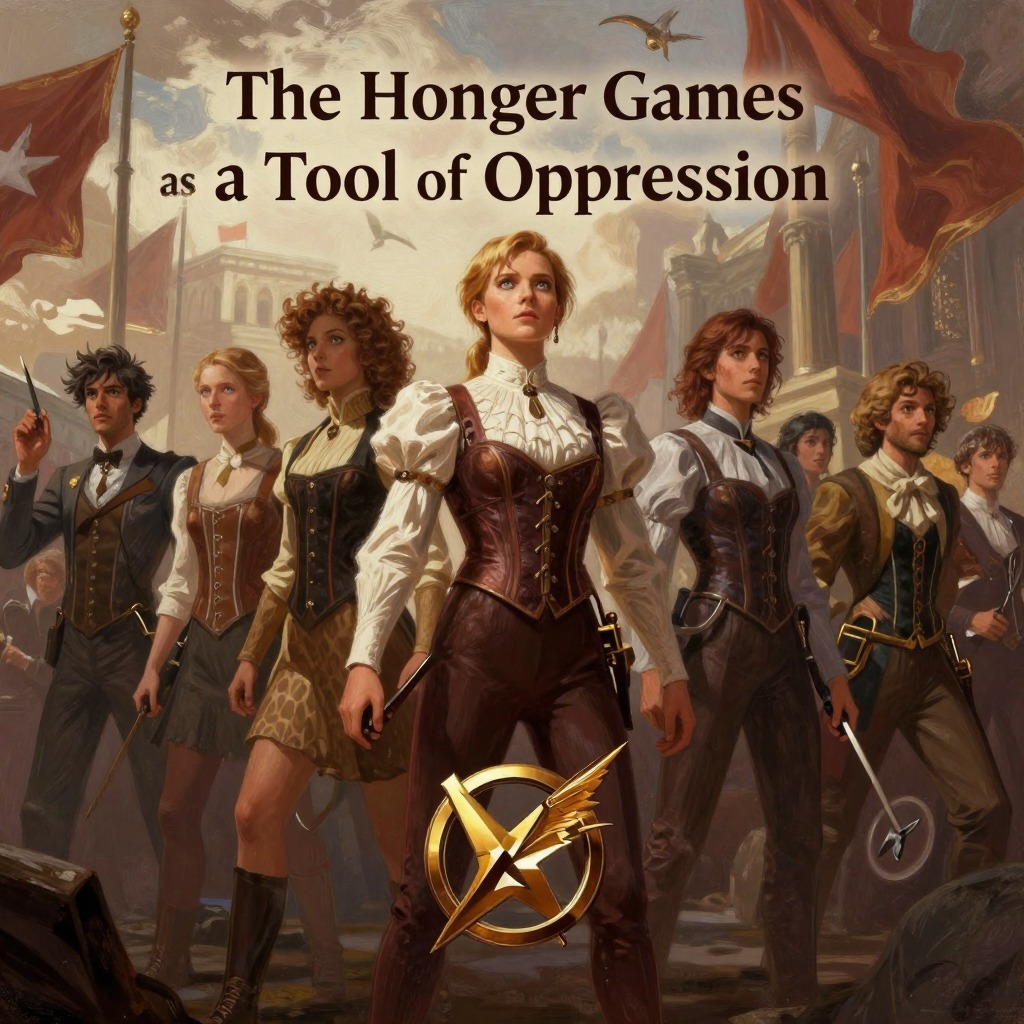
The Hunger Games
The Hunger Games are the annual, state-mandated competition at the heart of Panem's system of oppression. Instituted after the failed rebellion known as the Dark Days, the Games are a punishment for the uprising of the districts against the Capitol. The Treaty of Treason, which ended the war, established the Games as a yearly reminder that the Dark Days must never be repeated. The official narrative, recited each year at the reaping, frames the Games as both a time for repentance and a time for thanks, a twisted justification for a spectacle of violence.
Structure and Rules
The rules of the Hunger Games are deceptively simple. In punishment for the uprising, each of the twelve districts must provide one girl and one boy, called tributes, to participate. The twenty-four tributes are imprisoned in a vast outdoor arena that could contain anything from a burning desert to a frozen wasteland. Over a period of several weeks, the competitors must fight to the death. The last tribute standing wins. The Games are broadcast live across Panem, making them a mandatory viewing event for the entire nation. The Capitol uses the Games to remind the districts of their total subjugation, with the real message being: "Look how we take your children and sacrifice them and there's nothing you can do. If you lift a finger, we will destroy every last one of you." To add humiliation to the torture, the Capitol requires the districts to treat the Hunger Games as a festivity, a sporting event pitting every district against the others. The last tribute alive receives a life of ease back home, and their district is showered with prizes, largely consisting of food, while the rest battle starvation.
The Reaping and Tesserae
The selection of tributes occurs at an annual event called the reaping. Children become eligible for the reaping the day they turn twelve. That year, their name is entered once. At thirteen, twice, and so on until the age of eighteen, the final year of eligibility, when their name goes into the pool seven times. However, the system is heavily skewed against the poor. Families who are starving can opt to add their names more times in exchange for tesserae, a meager year's supply of grain and oil for one person. This means that a poor child like Katniss Everdeen, who has been feeding her family since her father's death, has her name entered twenty times by age sixteen, while a wealthy merchant's daughter like Madge Undersee, who has never needed tesserae, has only five entries. The system is designed to plant hatred between the starving workers of the Seam and those who can generally count on supper, ensuring the districts remain divided and unable to trust one another. The reaping itself is a grim affair, with attendance mandatory. The square is filled with a sense of dread, and the camera crews, perched like buzzards on rooftops, only add to the effect. The Capitol uses the reaping to keep tabs on the population, as all twelve- through eighteen-year-olds are herded into roped areas marked off by ages.
The Arena and the Gamemakers
The arena is a controlled environment designed by the Gamemakers, who manipulate the terrain, weather, and threats to ensure maximum drama for the Capitol audience. The arena can be anything from a burning desert to a frozen wasteland, and the Gamemakers are known to introduce traps, such as fireballs, tracker jacker nests, and muttations, to force tributes into confrontation. The Gamemakers' primary goal is entertainment, and they will kill a tribute if it makes for a better show, but their real sport is watching the tributes kill one another. The arena is also a historic site, preserved after the Games and turned into a popular destination for Capitol residents to visit and vacation, where they can rewatch the Games and tour the catacombs.
Sponsorship and Mentors
Each district's tributes are assigned a mentor, a past victor from their district, who is responsible for advising them, lining up sponsors, and dictating the presentation of any gifts. Sponsors are wealthy citizens of the Capitol who back tributes, either because they are betting on them or for the bragging rights of picking a winner. Gifts, delivered via silver parachutes, can be anything from food and medicine to weapons, and can mean the difference between life and death in the arena. The mentor's ability to secure sponsors is crucial, and a tribute's popularity with the audience directly impacts their chances of survival. The system is deeply flawed, as mentors from poorer districts like District 12, who have few past victors and little influence, are often unable to secure the same level of support as those from wealthier districts.
The Role of the Audience
The Hunger Games are a form of mass entertainment for the Capitol, and the audience's reaction directly influences the events of the Games. The tributes' interviews, training scores, and actions in the arena are all designed to win favor with the crowd. The Capitol audience is depicted as decadent and detached, treating the Games as a sporting event and the tributes as celebrities. They are excited by the spectacle of violence and are quick to cheer for the most charismatic or brutal competitors. The audience's response can also be a form of political pressure, as seen when the Gamemakers change the rules to allow two victors from the same district after Peeta Mellark's declaration of love for Katniss becomes a popular narrative. The Games are a tool of propaganda, and the Capitol carefully controls the narrative to maintain its power.
Significance and Legacy
The Hunger Games are the central mechanism of control in Panem, a brutal reminder of the Capitol's absolute power and the districts' complete subjugation. They are a tool of psychological warfare, designed to break the spirit of the districts and prevent any future rebellion. The Games also serve to divide the districts, pitting them against each other in a competition for survival and resources. For the characters, the Games are a crucible that forces them to confront their own morality, their capacity for violence, and their will to survive. Katniss's journey through the Games transforms her from a simple hunter into a symbol of rebellion, and her final act of defiance—threatening to eat the nightlock berries with Peeta—becomes a direct challenge to the Capitol's authority. The Hunger Games are not just a competition; they are the defining event of the novel, shaping the lives of all who participate and setting the stage for the larger conflict to come.